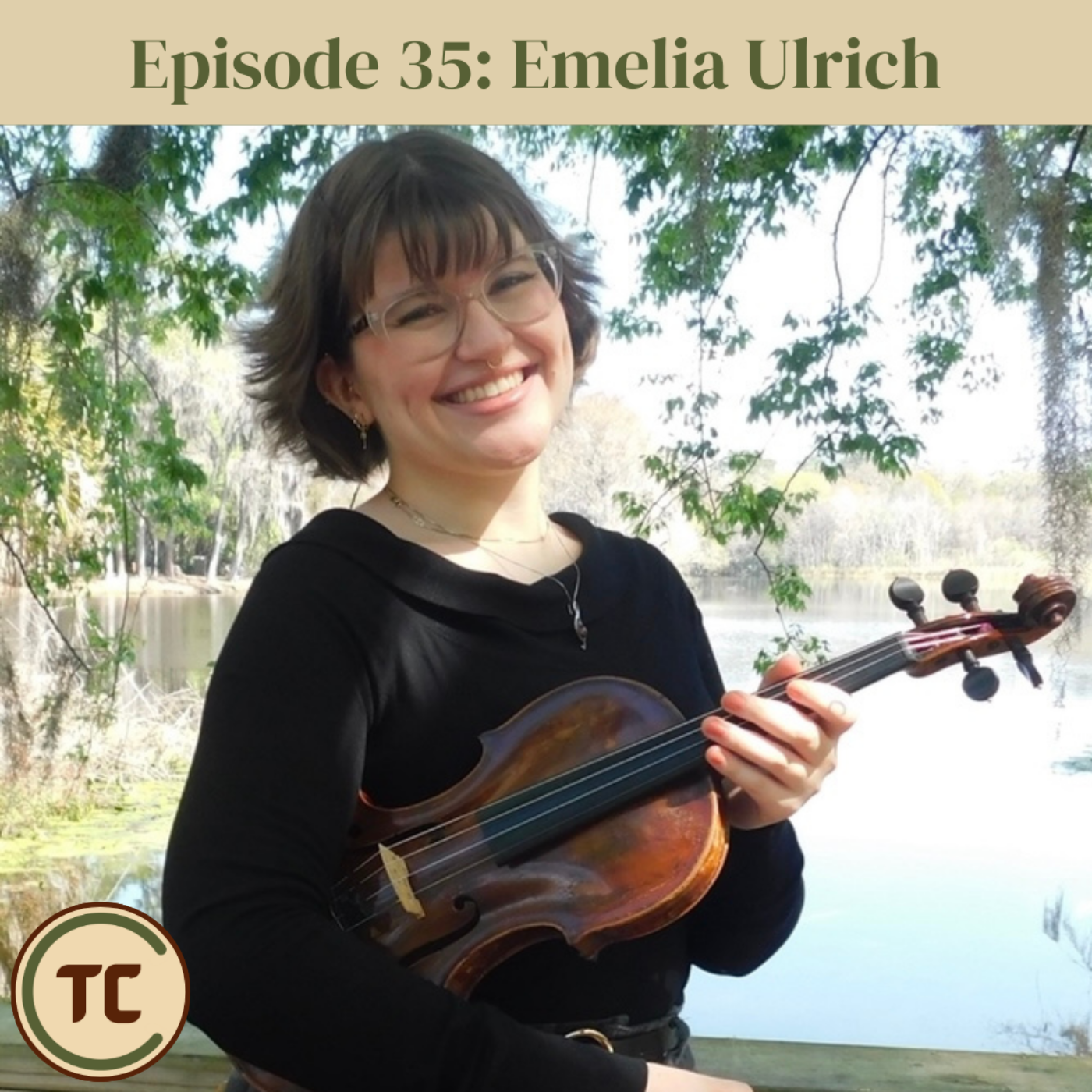
TCC 35. Vigil - Emelia Ulrich


 Spotify

 Apple Podcasts

 Amazon Music

 YouTube

 iHeartRadio
This episode of the Theorist Composer Collaboration podcast features the composer Emelia Ulrich and her piece Vigil . Music theorist Aaron D’Zurilla talks with Emelia about her background, philosophy in music, the piece Vigil , the place of music theory in composition and much more!!
Donate to the TCC: https://buymeacoffee.com/tccollaboration
Citation from episode: Bourne, Janet. “5. Topic Theory and Film: Coming of Age in 1994’s and 2019’s Little Women.” In Film Music Analysis: Studying the Score , 1:87–109. Ed. Frank Lehman. United Kingdom: Routledge, 2024.
Make sure to follow the TCC social media and hosting accounts on:
Facebook: https://www.facebook.com/profile.php?id=61557900086297
Instagram: https://www.instagram.com/tc_collaboration/
Website: https://www.tccollaboration.com/
TCC Theme composed by Will Davenport
0:21 Welcome to the Theorist -Composer Collaboration, a podcast interview series highlighting modern composers and music theorists. My name is Aaron DeZarilla, I'm the host of this podcast and also a music theorist myself. Today I will be talking with the composer Amelia Ulrich alongside her piece Vigil. I talk with Amelia about her background, philosophy in music, the piece Vigil, the place of music theory in composition, and much more. I also want to give a content warning for this episode, containing discussion of grief, loss, and terminal illness. So, with that, here is an excerpt from Vigil, and welcome to the Theorist -Composer Collaboration. Again, the music that
4:04 you were just listening to is from the piece Vigil by the composer Emilia Ulrich. Speaking of which, Emilia, welcome to the podcast. How are you doing? Thank you. I am doing well. Preface, apologies for the hoarseness of my voice. I'm not sick, but my voice is a little bit husky right now. But I'm doing well. How about you? Good. I'm doing well. You know, this is graduation season and you still have one more year of your master's, which we'll get to in a second. But I just graduated this past weekend. So lots of exciting things going on with that. But how about you go ahead, tell the audience about yourself personally, professionally, academically, whatever you choose. So I am a current master's student in composition at FSU. Yeah, in composition.
4:58 I am also a professional violinist and violist. I play with the Gaines Orchestra and the Ocala Symphony and gig around and stuff. Yeah, I am writing a lot of music right now. It's very fun. I am enjoying it. Now, Amelia and I knew each other at University of Florida. Of course, we know each other now, but we... first met at university of florida when i was doing my undergrad at the same time as her we were both in the violin studio amelia i've always wondered because you're dare i say primarily a violinist yes how how do you keep up the finger dexterity and finger health switching between viola and violin um not practicing enough um uh i think Okay, it helps me a little bit that I feel like viola parts are kind of a vacation for my hand. Oh, wow. I love playing in the viola section, but it's not as demanding to me personally as the first violin section.
6:08 So even though the hand spacing is a lot harder, it isn't quite as strenuous. That's my take on that. Granted, I'm not playing solo stuff on viola typically either. So I'm sure that would change if I were. Certainly, certainly. And, you know, I also know that you are quite the gigging person. And I also know that you will be, you know, doing a graduate assistantship in the second year too. How do you find time to... you know, be when I, you know, you're a part time performer, but it's like if you were to do it in hours per week, it's it's quite the part time job that you have going on for yourself with the amount of performing and practicing that you do. How do you keep up with that with your studies? And that's not what your degree is. It's composition. How do you keep that up?
7:02 Yeah, I just kind of do it. I don't know. I feel like. I think I'd go crazy if I just didn't do it. I don't know. I think it's just a huge part of my identity as a composer. And my life would feel like empty. So I just do. I don't know. It's not even a thought in my mind. I'm like, I just do it. You just do it. I just do it. I'm contracted. I go. Fair enough. Speaking of that, yourself as a composer, how would you describe yourself as a composer and extensively your music? I think if I'm getting really technical about it, like post -minimal, a lot of pan -diatonic stuff happening, like non -functional harmony.
7:49 But a lot of my, like the focus of my music, I think I focus a lot on personal experiences and then kind of weird, like obsession type of things. Like I was... I haven't finished this piece, but I was writing a piece about, I heard these frogs outside and I took a little recording and I was like, oh my God, these frogs are doing like crazy polyrhythms right now. So that kind of stuff, like things that my brain like attaches itself to, I think is a lot of what I write about. And of course, as a string player, I love writing for strings. So I have a lot of stuff for strings, which is what the audience is hearing today and what we're talking about. Yeah. Yes, fair enough.
8:32 And what if you were to identify like what composers have you found instructive to yourself or what music do you like or liken yours to, you know, post minimalist, lots of different angles you can go with that. It's not going to say trendy, but it's certainly a big pocket of calling something trendy is kind of weird in composition, because 12 tone was trendy, like For 30 years. Yeah. And that's not how that, and also let us remind ourselves, for 30 years, over 100 years ago. But anyways. Not contemporary anymore. Yes. Do you remember Gabe Gokoski's hat? Schoenberg is not contemporary. I think so, yeah. Yes. That was always very funny. But what composers do you find inspiration in? I feel like I find inspiration in different composers for different reasons.
9:34 I love Holst for his orchestration. I think his orchestration is amazing. And I don't write that much for orchestra. But I think it's just sparkly and clean and beautiful. And I love Stravinsky for how weird everything sounds in his music. Like with Tamverly. I really gravitate towards... Like today, contemporary, I love Caroline Shaw so much. I really love Sarah Kirkland Snyder. And then I feel like a lot of times I will go towards like specific pieces by specific composers, like more than their entire catalog of work.
10:15 Oh, I will say I really love John Adams, of course. I had a moment with Chairman Dances last year. It was like the only thing I was listening to. Yeah, I think that covers like the composers that probably have the most influence on me. Fair enough. Yes, I particularly like Caroline Shaw as well. I remember for Composition Skills 3, Dr. Sane had us go through or pick a contemporary composer and go through and catalog their entire back catalog and give notes on all of their pieces, which... Halfway through, I remember thinking, I wish I picked someone who was not as well -known, because Caroline Shaw has many, many, many pieces, but I very much can appreciate her catalog. Aaron, you're not going to believe this. I did Caroline Shaw for that project, too. Oh, you did? The year before, yes. Also, it's hard to find some of her works. They're not recording. She has written this, but I think she has a violin concerto.
11:21 She has written this. No evidence of it anywhere. I'd love to hear it. It is odd how much music is just non -existent. And that's like for, you know, obviously there's the archival historical part of there's lots of erased compositional history, particularly of marginalized composers and female composers. But also even today, it's just like there's no evidence of some music existing. kind of it's pretty crazy just elective like maybe she who knows maybe she didn't like the piece and she's like you guys are not gonna hear it anymore but we have no idea yes yes certainly which is funny in the digital age you usually don't have that experience of not being able to find something but We're so privileged. It's quite frustrating when you can't find something immediately. And yet it's possible. She is proving it is possible to erase something from the internet.
12:23 So today, in your compositional catalog, we're going to be talking about a piece titled Vigil, which is a six -movement work. We'll be going through each of the movements for string quartet. As very clearly in the program notes, and we'll be discussing this a fair amount, I'm sure, throughout this episode. But can you please give the audience the story and the background of Vigil? The sort of inception of this work is actually the final movement. I originally wrote it, I've revised it since, but I originally wrote it during undergrad. And I always knew I wanted to make a larger work out of it. I so when I was working on this piece, my dad had brain cancer and I played like the rough MIDI draft I had for him before I even had note performer. So it did not sound good.
13:21 And I played this. I played like the first 10 bars I had in when they were in that state. They're probably not even the same anymore. I played that for him. And that was. the last piece of my music he ever heard. So it wasn't always like about him, but it sort of became about him. And in that way, I wanted to, in writing like an entire string quartet based or starting with that movement, and I knew it was going to be the last movement, I wanted to have it serve as a memorializing piece for him. And I, along the line, like along the I don't know timeline I eventually wrote like titles down because I in my mind I was like I'm gonna write this quartet eventually so I had titles of movements written um except for the fifth movement the fifth movement uh was a suggestion by my professor that I needed a an in between between movements four and six um but all the other ones were pre -conceived of uh in my notes app on my phone. And so I wanted to make a piece that was kind of all -encompassing of my dad. It starts with sort of the inception or my conception of him and goes all the way
14:52 through what happened with his cancer and then me reflecting on it. So that's kind of the whole thing. In one bubble. I wrote this question later on for the podcast, but I want to ask it now. So I, in my own experience, I have written a memorial piece as well. I'm going to generally call it that. You may not see it as that, but whatever. A piece that memorializes a person who had passed away, who was close to me. Now, I'm also not a composer, and I'm not nearly as finely trained as you, but... You are a composer.
15:32 You write music. You're a composer. How about not? That's not at the top of my CV. How about that? Okay, fair. But I don't have nearly as much training as you do when it comes to fighting blocks in the mind and so on. But I found the process particularly... painful to write through. Any writer's block, any stumble or anything was heightened in its importance because it's like, like you were just saying, this piece encapsulates your father. And what I hear from that is that must have, I would feel a lot of pressure. It needs to be perfect. And so what is that like in the process of composing? I would say I think I kind of have that going on in my brain always when I'm composing. So I don't know if that element was particularly different for me, like throughout the writing process. I definitely have moments like writing something where I really thought about it. Like when I was writing the kind of mood expressive markings in the piece, that was really emotional because I was thinking a lot about like. what this represents or like when I was writing my program notes, that was really emotional. But during the actual composition process, I think I get very like in my composer
17:05 headspace and it's not detached per se, but once I know what I'm going for, I can kind of just go for it. But I definitely did have. Many moments of like writer's block for sure, like not knowing exactly what I wanted to do or not having the motivation to do it or because it it was difficult. So, yeah. So the original portion of this piece was what ended up as the final movement is what he heard. But when did you put all this together, this piece, like as it is in this podcast? As it is in this podcast? I think finalized version, probably. I was prepping it for a submission for a competition. So final, final version would have been like April 15th. But I finished composing it in like December or January. I think January.
18:03 All right. So it's 2025 and he passed away in 2021. Here's this might be maybe more of a personal question, but why now? Why? bring it to life now in the way that it is? Um, in a very, uh, maybe not utilitarian way, I had to write something and I was writing it. I was writing that frog piece and I did not like what I was writing. And I was like, I've been wanting to do this for a long time and now I have like the creative space and the guidance to do it. And so kind of that, um, I think also like feeling comfortable enough with it. It took a while. I think if I was too emotional, I mean, I'm still emotional about it, but if I was, if it was too, like this just happened, I think it would have been a way different piece. And I wanted it to be more reflective than that. Fair enough. And also there's nothing wrong with a little bit of utilitarianism. We got to use what we have. Yeah. I needed to write something for my comp lessons. I was working on that frog piece and I was like, God, I hate the way this sounds. And then I was like, I just don't even want to work on this. I'm going to start writing the string quartet. So let's start with movement one. Now, all of these movements have very particular titles and I want to talk
19:34 about them one at a time. So this is movement one. You had a dark ring around your iris. Can you tell us what that title means in relation to the overall piece? So this is kind of like the starting point inception of I wanted to create an image of my dad before going like pre -cancer, like just going like he's coming into being and then eventually get into what else happened.
20:50 So I wanted a movement that. sort of set up this story but wasn't fully involved in in that aspect of it so dark ring around your iris he had a dark ring around his iris oh okay fair enough that makes sense with that and yeah you know the the texture of this movement is probably i would say unscientifically, probably the closest to that sort of like post minimalist idea that you have going because of the shoulder instruments of what they're doing. It's a very dense and restless texture. And until the melodic function of the cello comes in, you can't really tell what meter it's in because of the different phasing and layering. And it's like this wispy sea of notes. And what led you to orchestrate the movement in that kind of, I don't want to say confused, but let's say hazy kind of way? Yeah, I love doing that. I love confusing the meter. That is my favorite thing. Maybe. Yeah, I had the first violin in my mind at first, and then I wanted it to not be as like... this is the beat, this is the meter we're in, you know, like, I wanted it to be more fluid than that. And like
22:22 changing, I like when, you know, parts interlock in different ways. I think one of our professors, Dr. G, he uses this in our digital synthesis class, but he talks about the concept of anti -loops I think he came up with that but it's like it sounds like it's looping but it's actually not with the way things are lining up um so I think that concept is cool and applying it to like acoustic music I think works really well also um so yeah I like to create little fluttery things happening that are different every time but in that way subvert expectations and don't make it Too boring. Fair enough. Certainly subverting expectations. Some of that Stravinsky -esque and John Adams -esque sort of metric manipulation that you have going on. So let's go on to movement two, titled Butterfly Mass. What can you tell
24:09 us about that title and the overall conception of it? Yeah. So what the brain cancer that my dad had was a glioblastoma. And just for context, because I had never heard of that in my life before, that is probably the, I can't speak to this exactly. But my impression is that that is like the most aggressive brain tumor. It's extremely fast growing. It's malignant. It like takes over whatever part of the brain it's in. It has like tendrils so you can't even really operate on it. And even if you're able to like shrink it or eradicate it with chemo and radiation, it comes back. extreme malignant brain tumor.
24:59 Specifically, he had a butterfly glioblastoma, which is that it's on both hemispheres of your brain. So it was on both sides, like on the center, like top of his brain, and it covered both sides. So butterfly mass is like butterfly as in that kind of tumor, and then mass as in tumor. But I thought, it would be interesting to play on those words, like mass as in Catholic mass. He grew up Catholic and granted I didn't grow up Catholic, but I thought the idea of taking my uneducated conception of like the music of a Catholic mass and taking that as inspiration and then taking the idea of a butterfly and adding that into. So I, I, I set out with like a very like homophonic kind of feeling, which in my brain is Catholic mass -y. And then I wanted this butterfly to be kind of floating around the whole thing as like a really little beautiful twinkle of light. But in reality, it's, you know, that's not what it is at all. So kind of just playing on words like that. See, I was, I got the, obviously I didn't know the details of, your father's uh cancer so i didn't pick up yeah on that actual meaning but i got the mass part
26:33 i understood it as a um but also with the butterfly part i thought of it usually i don't know when i say usually i don't quote me on that but i always get the vibe whenever a butterflies are invoked it has something to do with rebirth because of the stages of becoming a butterfly which i guess in this case um morbidly would be the growth of the cancer because it could be or i guess it could be like that i'm creating new stuff out of this horrible thing that happened you can see it that way too that's a more positive way let's choose that and also i you know i want i was going to say it at the at the at the end of this like talking about the movement sort of things but i i just want to acknowledge that you're that you're very candid about all of this and i i appreciate you sharing it um i'm almost surprised how candid you are with all this oh yeah this is pretty heavy yeah it's it is pretty i did have practice in uh i presented in comps like a forum uh a couple weeks ago That I was not as comfortable with. It also helps, you know, I've known you for a really long time. Like you're a very comfortable person to talk to. Compliments.
27:59 Thank you. Good podcast host, but it definitely makes it a lot more comfortable. But I've talked about this topic, you know, a lot in the last few years. So as much as I'm, you know, you're always mourning and grieving, but like I am now much more. comfortable talking about it i think in comp forum i was not and the first time i talked about writing this piece with my professor last fall i was not she was very supportive um uh oh also something that i'm thinking about now regarding the title of the piece that was brought up in comp studio when i presented it the concept of like if it's a mass of butterflies that i think does not apply I just thought I'd bring that up. It's not a big group of butterflies.
28:52 I don't think most people will confuse it as that. Yeah. With all these multiple meanings, I just wanted to clarify this one kind of doesn't apply. It's not a swarm of butterflies. No. Okay. Yeah. But yeah, I just wanted to address that, this incredibly heavy topic. I'm happy that you're okay talking about it, and I appreciate you bringing it onto such a public forum as well with this. Yeah, it's cathartic. I was thinking catharsis. I'm like, that's not the right conjugation of that. It's cathartic. So let's move on to movement three, titled Where Your Back Was Still Warm.
30:46 Now, Amelia, we were just talking about your candidness with this. I'm a little bit nervous to ask what this title necessarily means. Can you please share? Yeah, this is probably... I guess maybe we should have put a trigger warning at the beginning of the episode. I'll put one at the very beginning of the episode. Okay, cool. This is when it applies. So, I was the... only member of my family who was not there when my dad died. Like, everybody else was there. His mom and his dad, my grandparents, who are divorced, were both there. And my mom and my brother, they were all there in the room when it happened.
31:28 And when my mom was on the phone telling me about, like, what went on, I think he loves Star Wars. I think they had Star Wars playing, which is very sweet. And she told me when like the EMTs or whoever paramedics came and took him away, they touched his back where it was still warm. And that always like stuck with me from that phone call. It was just like such an interesting detail to include, but so like tender. And I thought like this sticks with me so much. I just have to use that as like the title of like the movement about him dying. So that is that title.
32:21 Yeah. And I wanted it to sort of feel like a lullaby a little bit, but obviously it descends into not a lullaby. This was the movement where, at least emotionally, the weight of the subject started to kick in for me. Not just title, but I would compare this. I don't always like to say, oh, you sound like this composer or so on. But just for reference, it felt very quartet at the end of time, kind of. That kind of dread or emotional density. to the texture. And I feel, you know, I feel like up to this point, this movement might have been pretty difficult to compose on that level. Yeah, it was at first difficult for me to compose because none of the playback sounds worked. I had to really, really like abuse Dorico to get playback to work. But yeah, I knew this was going to be like, the heaviest movement, like the center of the piece pretty much. I mean, now it's not five movements, so it's not exactly the center of the piece. But it's, yeah, I knew it was going to be heavier and I knew I kind of, I wanted it to start like a lullaby. I wanted it to not be as busy. Kind of sounds like, it doesn't sound like tinnitus, like violin harmonics don't sound like tinnitus,
33:53 but like I wanted that kind of. feeling like very still very just pure and then eventually as I was writing it I didn't keep it as a lullaby necessarily like the third iteration of the melody like devolves and yeah so it kind of became a lullaby into like screaming outpouring of grief type of feeling yeah And so earlier in this podcast, you described the piece as a whole and the progression of movements also as a linear progression of time. So we're about to move on to the next movement.
34:40 I'm asking this because of that title. In the timeline of the piece and in reality, he's now passed away. Yes. Okay. And I ask that because Movement 4, titled My Hands Now Shape Just As You Were. So, yeah, this is where the more reflective
36:14 part of the piece comes in, where I'm thinking about the impact my dad had on my life. And I think it's huge. I always thought my hands kind of looked like my dad's. And so when I was coming up with these little titles in my notes app, I just felt like that was an interesting way of reflecting on that. He impacted me so much and, you know, is evident in like every part of me. Like it's evident by my genes. It's in the shape of my hands. It's in the color of my eyes. It's like the bump on my nose. It's in everything. And so connecting that to like the physical element of him being my dad, my biological dad. I thought was apt. And so I always thought his hands looked like my hands and I wanted to, again, like play on that. So I, it's a lot of octaves. So like the handshape of the instrument, I don't do that to the cellist, but for violin and viola, a lot of octaves because that's, you know, the handshape of the instrument. I eventually break that rule, but I thought that would be a funny way of. incorporating that that's so fascinating that you included an element of like embodiment in the physicality of how it's played
37:46 i read it as you know through the notes they sent you a little bit differently is that you know when you're you're talking about yourself as a reflection of your father uh i think of you know the different elements such as the octaves and the at least for those moments, relative melodic and harmonic simplicity. And also the little plucky pizzicato elements in there as kind of like a calling to the audience to recognize it as like childlike or whimsical. And I don't want to call your music simple, but like a simple sounding texture. And that made me think of something in topic theory or something that I thought of, or I saw recently by Janet Bourne, the childhood topic in film music, which I'll have a citation in the show notes for everybody in the description if they want to go ahead and read Janet Bourne's contribution to topic theory with that. But, you know, what topic theory is for the listeners is, generally speaking, it can get pretty complicated pretty quickly, but when it applies to, like, film music, it's different elements within music that... generate specific thoughts and feelings in listeners, in audience. So in this case, we have simplistic harmonic movement, simplistic melodic movement, the act of lots of perfect intervals, one after the other, and the kind
39:18 of plucky pizzicato cello, although not scientific in my diagnosis here. This is... Very similar to evoke the sense of simplicity and naivete that we associate with childhood. An example in Janet Bourne's writing that she uses is some of the introductory themes in Inside Out. When Riley is born, the soundtrack has a lot of these very similar things and it's to evoke a sense of innocence and so on. So I will put topic theory to the side for the moment because that's not what we're talking about here and it can get really complicated really quickly. But that's just something I thought of with this movement that I thought was pretty cool. So again, link in the description to Janet Bourne's work with that. Yeah. Regarding that, I actually, I do definitely agree that like the later middle section with the pizzicato and like even right before that, I think there are for sure elements where I was like going for a childlike wonder. I don't know if necessarily the opening I was thinking about that with the octaves, but as it, you know, eventually. Like the rhythms get smaller and smaller and smaller. And then it becomes a pizzicato section. I think for sure that is in there. And I also, you know, in my expressive markings and stuff, that is like pretty explicit. Yeah. Yeah.
40:46 I certainly thought, especially at the moments where you have the broken octaves, where it's played separately. It was very fun. It was a very fun movement for me. At first, I was very like unconvinced of what I had written. But the more I thought about it as like once I had written these expressive marking, like the like basically poetry I have going on with the music. I don't know if the audience is going to be able to see that. They can if you're able to show it to them. I don't know. You have my permission. But once I really connected to that sense of like this is a. connecting back to childhood it like a lot of what I had already written like clicked for me a lot better and actually it was my professor that pointed out that it sounds like childlike and I was like huh I didn't I hadn't thought about it that way but yeah and it makes sense for what I was writing like reflective like all the way back to the beginning basically certainly certainly and so going on to movement five everything I wish I could tell you about What rationale
42:51 were you thinking when how you wanted to express what you could tell him about? Because everyone could have a different idea with something that wide open. But why did you choose the approach that you did? Yeah, so I think when it was posited to me by my professor that maybe there should be some sort of. that some sort of musical thing happening between movements four and six, which were then four and five. She framed it as like, we need a return to the first movement for it to feel like in a narrative sense, complete.
43:32 And I totally agreed with that. And I did, I loved like the material I had in the first movement. So I was very happy to do that. And now I think actually the fifth movement is kind of like, For me, the most fun to listen to. I love the fifth movement. So I'm very happy that she pointed that out to me. In the same way that the first movement feels, like, all -encompassing and, like, this... I don't know. To me, it feels like the formation of, like, a galaxy or something. That's kind of, like, the formation of this entire person, like, just from thin air. It kind of feels like this, like, dissolving of this same idea. Like... Everything is kind of coming apart in the same way, but not in like a negative way, just in a way of like. I don't know. Again, I'm not religious, but like from dust, we come into dust, we return. I don't even know if that's like the exact if I'm quoting that correctly, but that kind of idea, like totally forming out of nothing and then going back to being of nothing.
44:36 So that that was kind of my way of it's not even necessarily. That there is anything in the movement specifically that I want to tell him about. And yet it's like the feeling of wanting to tell him about things. Like every time, granted, I don't think Marvel movies are holding up, but like every time a Marvel movie would come out, like at first, like I think WandaVision came out after he died and he loved superhero movies. He loved Star Wars. Every time that would happen, I'd be like, God, I wish I could call my dad and, like, tell him how cool this show is. Like, stupid stuff like that. And then more important things. Like, getting into my master's degree at his alma mater. Like, I'm at FSU. That's where both my parents went. And I didn't get in for music in undergrad. And that was a huge thing.
45:30 And, like, being able to tell him about that, like, huge step in my life that would be so meaningful to him that I can't tell him about. So like those kinds of things, like big and small, but the feeling of not being able to tell him about things, I think is probably what I was going for more. Understandable, understandable. And in that same line of that kind of cycle of generative, you know, formation of a galaxy and then I don't know the exact quote either, but from Dust We Come and so on, I suppose that. goes in line with the title of Movement 6, and so we start again. I was I was a bit confused by that title.
47:54 Is that in line with that same thinking? I guess you can interpret it to be. All right. What is it actually? Well, I originally, you know, that movement was on its own. It was totally standalone. And so my thing when or my idea of it when I first wrote it, like that is the original title I had for this. It started as a different piece. Anyway, I originally had like a violin cello duet that had that material and then I turned it into a string quartet and then that's what my dad heard. But that violin cello duet does not exist anymore. So just like that Caroline Shaw violin concerto. But when I was writing this originally as its own thing, it was kind of the feeling of like, and we still like, Get up every day like this. This insane thing happened and we still get up. I think actually when I was writing it, I have clinical depression and I I think I was writing more about my depression, honestly, than it was about my dad. But I mean, the same feeling applies there. Something horrible happens. You still get up every day. You still push through it. You start the day again. Like something horrible happens. You get back up.
49:20 So that was kind of the idea with that one. Yeah. I can relate to that feeling. Earlier in the podcast, I referenced that I've also written a memorialized piece for someone that I knew. It was my grandfather. And I remember when I first found out that he had passed away, which he... Let's say it was not ceremonious in the slightest. And he lived in upstate New York. I live in Florida. You know, that's quite the distance away. And I was in Bradenton at State College of Florida in my first two years of undergrad.
50:03 And I remember pulling up for a string quartet gig at a luncheon. fundraiser at the img golf club i put my car in park i got a phone call from my mother that he had passed away i had a good cry for a couple minutes and then i had to get my violin out and i went and played christmas music for about an hour at that luncheon and then later that night we had the school's like a winter concert So talk about not being able to process it. And then because it's easy to, I just put that grief in my back pocket and went on with life, which turned out to be very not good for the following years. Yeah. And probably is why writing that piece was very difficult, because I just chose, because of circumstance, to not do anything with that grief. Yeah. I relate heavily. The day my dad died, I... I had just finished my online. It was during COVID sort of still. I just finished my online tuba final in a practice room for my brass skills class.
51:19 I'm sorry to laugh, but that just sucks. Yeah, it did. It sucked. So I did my tuba final over Zoom. And then. I was walking to the bus, the bus stop to go home. I got the call from my mom. I was like, oh my God. And then I was sobbing on the bus all the way home. And yeah, that was pretty much what happened. And I think I stuck around to play a Gainesville Orchestra gig like the next day, or I think that night we had rehearsals, something like that. So very relatable. Yeah. Being a string player. Yes. Yeah. Doing your tuba final. Yeah, right after. Yep. Of all instruments, it had to be tuba, too. I know. I'm just kidding.
52:08 Yeah, no, but for real, I hated tuba. Sorry to the tubists. I don't have the lung capacity. That's why I hated it. Yes, yes. Beautiful instrument. when other people play it though and so you know with the conclusion of this piece that you're you're ending the piece with what the original material was uh comprised of and now we've gone through this six movement journey uh this emotional roller coaster certainly what should as the audience we be feeling at the end of this piece or what is the intended pathos from How this piece ends. I think kind of like I was talking about, like catharsis. Okay. Is what I would hope for. I tried to, you know, end it on a positive note.
53:01 And also I want to credit my quote of my last two chords in the final movement. That is actually from the piece porch, which is at. Is it Alan Silverman, I think, is the composer from the end of Avengers Infinity War. Those are like the last two chords. And it's like Thanos looking over his field. And I just like that piece. I know it's like so such a silly thing. It's like a superhero movie. But I don't know that that piece. It's like a minute and a half long and it ends with those two chords. And it is just so beautiful to me. So maybe that's another inspiration on my writing. But I was like, I have to use these two chords somewhere. And I thought it was like such a beautiful and sad ending to a movie. And again, I'm still talking about a Marvel movie. And it feels so stupid. But I just thought it was like so beautiful. And like you have this like total devastation in this movie. And you see the person who did that just so peaceful and like happy with what he did. I mean, it's not the same thing here. There's no like evil.
54:24 Are you Thanos? I hope not. But I, I just thought that was so beautiful as like a weird mix of like pain and sorrow and then like gratification sort of and peace. And so, that's kind of like the end of that, I think is sort of the mix of emotions that I hope would happen at the end of the piece. I also, I do like in the performance notes, give the option of not playing the sixth movement, which, or actually playing the sixth movement in isolation. Granted, I think several movements could probably be played in isolation, but they're shorter. So I think, I think it would still work if like that same kind of idea would come across. If the sixth movement is omitted, like you still get an entire picture, like in a narrative form of this whole thing happening.
55:28 And I hope, I would hope people can, you know, see their own experiences with death and grief in that. Yeah, certainly. as we close out the conversation around this piece i want to thank you again for your openness and candidness of coming on to such a public forum to talk about your experiences talk about your father and share this very personal piece and want to give you the opportunity is there anything else you want to say about vigil not necessarily i just i really loved uh what i came up with like i i feel like a lot of times you know you're done with the piece you're like ah i i just i was able to capture the like essence of my dad and i i it's it's a very interesting experience and i'm very grateful for for you for letting me talk about it on here so yeah of course music music in many ways is um Both prescriptive and reflective of the human experience. And unfortunately, and so death and grieving is part of it. And that reflects into our music. And speaking of music in a general sense, as we go into this final third of the podcast, I like to just generally ask people, what does music mean to you? Oh, like everything.
57:04 I mean, easy answer. I don't know. I, I think like the, I always thought it was before I was a musician, like the music saved me. I always thought that was kind of like cringy, but like actually being a musician, like absolutely. Like I, I thought I wanted to be a, well, first I thought I wanted to be an astrophysicist and then I thought I wanted to be a mathematician. And then I had the two worst math and physics teachers ever in high school for two years. in three years in a row. Nice. And yeah, it was awesome. My senior year math class was me and one other girl. And the previous year, it had been two guys, two girls, me being one of the girls. And the first day of senior year, my teacher went, you know, if you would have told me it would have been the two of you who stuck around for senior year, I would not have believed you.
57:58 Well, what is wrong with people? I don't think he's a teacher anymore. Good. Yeah, he was horrible. So anyway, I had some really bad experiences with what I thought were like the path to my entire life. And music was like the one thing that, not that it was like the one thing left, but it really was like the one thing left that felt like embracing in that way. And I just I always knew or not always because I didn't start music until middle school. But once I started playing violin, I was like, yeah, I'm not going to stop doing this. Like there's no reality in which I'm not playing violin or making music anymore. And then later I knew it was composition.
58:46 But there was like not a moment where I was like, yeah, I'll give this up someday. So it felt logical. Like this is the one thing I have that I know I don't want to give up. And in that way, I just like poured everything into music from then on. And it did, it feels like it did save me. And like, it still sounds like cringe coming out of my mouth, but like, it really, that's kind of like what happened. Understandable. And yes, it is a little bit cringe without, without the context with it. It makes sense. I wish I had a better way of saying it. yeah no it's like when when you hear a like a like a 10th grader say that music saved them i'm like damn yeah you're in 10th grade like chill like i know paramore isn't probably around anymore but back then it had been like paramore saved your life like that's that's the idea in my brain like yeah yeah more saved my life i i actually personally have had a handful of moments where I'm like, I can see myself not doing this. And probably because our experiences or choice of engaging with music is a bit different because I'm significantly not a performer at all in the same way that you are. So I don't engage with that performance aspect. often criticized part of music theory which sometimes it has merit sometimes it doesn't
1:00:18 this criticism is the detachment from the actual musical experience in a number of ways and so and when you're going through music theory graduate school you know to learn and become better in all the capacities you want you have to detach yourself sometimes it's just it's when you take a passion and then you do it every day, it becomes work. And so sometimes it can be very laborious, especially in my case, when you have a discipline that to learn certain modes of an analysis, you have to detach yourself. And so I've had many times where I'm like, I can see myself not doing this. This is kind of depressing and whatever.
1:00:59 I was being just a bit dramatic and emotional at that time. But, you know, At least for me, when I see in other people it. OK, so I just wrapped up teaching the songwriting class at Florida State for the final time. So it's not music majors. And during the final exam, when people would they would present their final song project, they had to write a song. We would play it in class. Then I would ask them, you know, what major are you? What year are you in? What do you plan on doing? A lot of business majors, some stats majors, a lot of not related things to the class. And I find it just absolutely humbling to my own position, to yours, and to a lot of the people in this field. And it was heartwarming to hear a business management major after business management major, where I'm like, is that what you want to be doing? Or, you know, what do you want to do? And they're like... It's a job, but what I really want to do is music. And that is like the story of nearly every person in all of my classes. It is quite a privileged and phenomenal experience to have so much of your life centered on music. And sometimes I need to remind myself about that. I definitely feel you on that. when
1:02:29 I think about it I'm like oh my god I like how did I get to be doing this like it is like an immense privilege like to be able to interact with music every day as like the main thing that we're doing it's I feel like I'm gonna get on a pedestal right now or podium or that's all right I do that I do that a fair amount too yeah it's especially okay with what's going on politically with I don't know. We're in Florida. Jacksonville University just totally eliminated all of the arts. We have the National Endowment for the Arts being totally eliminated. I don't know, cut in some way. I don't know exactly. It's bad.
1:03:14 It's being threatened to be completely eliminated. It's not good. Art is what makes us human. I just don't understand. It's crazy that we're trying to make a world without art. We're trying to make a world where it's impossible to make art. Not that they think we should get rid of art, but they're taking steps to get rid of art, basically. They're taking steps to make it impossible to make art. And I just don't... Is that not what we all want to do? Why is AI making art for us? Why is AI not facilitating the other stuff so we can all make art? I just don't...
1:03:57 That is, it boggles my mind what is going on with like the state of society and its relation to art right now. It's, yeah. So that's, that's my thoughts on that. It boggles my mind as well. And I'm actually glad you brought that up because in those sort of political discussions, I'm happy to tease that in the next episode. after this one will be with professor Michael Buckler, someone who has a lot to say about that. And I'm really looking forward to that. So I certainly will certainly welcome discussion of that. And yeah, I, I don't even fully know my opinion other than it's bad, but I don't, it's bad. Like there's so much going on all at once that it's hard to like formulate a plan or a plot to like, hold up any resistance especially when we individually are so limited in power especially if anyone is questioning our opinion or like what are we talking about uh i suggest you look up something uh in the artistic movement of the mid -20th century called soviet realism and you probably we'll see some parallels to what is happening now in the United States. Look at the history of Shostakovich and many Russian composers and artists after World War II, and actually during the entire Stalin regime. Yeah, when is the U
1:05:33 .S. government going to start employing theorists to analyze intervals again? Oh, yeah. I don't know if they know, like, I don't know if anyone in government currently is aware enough about music to know that that is a thing. You know they're not. Yeah, they're not. Or to even know that a theorist is a person you could hire to do that. Yeah, it's ridiculous. Only a forensic musicologist, which is just to win a court case with bullshit copyright claims. Yeah. Anyways, so for now, let's pivot off of that. That will be talked significantly more about with Professor Buckler in two weeks after this episode premieres.
1:06:25 But anyways. Let's go on to, we've already talked, we talked a bit about your relationship with music. So let's, let's get a little bit, let's go in a different direction. How about music theory? Where does that end up in your zeitgeist of like what music means to you? And you can also, I happen to be wearing a music theory t -shirt right now. And you know, you know who I am. But you can say something bad if you want. I think. I think. Okay. I think music theory is very fun. I love puzzles. And I think that is what music theory a lot of times feels like to me. I think I'm going to say an anecdote.
1:07:13 I realized a couple months ago in one of the classes I'm in. For the first, as a, okay, as a composer, you know, I love contemporary stuff. I imagine you do too, because you have this podcast. I don't think I realized like at our undergrad, like we didn't have a ton of theory majors. It was pretty much you. So you were the only theorist I knew of. Now I'm at an institution with a lot of theorists. I did not realize music theorists like classical music. what what my mind has been blown i'm like you guys like this okay define classical music in that like classical era sorry classical era music like mozart i'm like we're we're talking about like the differences between mozart piano sonatas right now i just have never that has never been a thought in my mind yeah so i love music theory i think it's super interesting I think the focus of the spotlight in music theory is probably what I would have an issue with.
1:08:23 So I'm going to deepen that perspective a little bit. And I'm not saying that you're wrong. I probably am. No, no, no. It's subjective. No, it's your perception is colored. in a very purposeful way by the music theory establishment, because in pedagogical terms, the answer to what you're saying is yes. Yes, that is the focus. Common practice harmony of the Western white male European tradition. The answer to that is yes. Now, I would encourage you, Amelia, someday to... I mean, this next one's going to be in Minneapolis, so maybe it won't be, you know, that's kind of a plane flight. I'm thinking we're talking about theory conferences. Yeah. I'm thinking about it. I'm thinking about it. Okay. I encourage you to come because I believe you will be more encouraged by the music theory academia because the wonderful part of music theory, in my opinion.
1:09:38 There's many beautiful parts to it. There were sessions on queer music, feminist studies, reggaeton, new living composers, disabilities in pedagogy, accessibility. Music theory goes so far beyond how it's represented in the pedagogical classroom for learning voice leading and learning. the very boilerplate elements of music. Now, in some ways, that's utilitarian. You know, if I want to show a cadential 6 -4, probably the easiest way to do it is take a slow movement of a Mozart piano sonata with the Alberti bass, and you can clearly see the suspensions going from 5 -6 -4 to 5... five, five, three, you know, so part of it's utilitarian. Part of it is historical exclusion. And part of it is part of it is narrow mindedness as well. So you're not wrong, but there is more to it than that. I just, yeah, I, and I also, before, before you respond, I was also surprised coming from UF and the more time I've spent at FSU or just away from UF, the more I appreciate the structure of the program at UF, that so much of it is composer -led, I found, I'm going to be a little ballsy here,
1:11:10 I found that within my cohort, I had the largest knowledge of contemporary composers out of anyone, because, like, to me, talking about Caroline Shaw is at the same level as talking about Brahms. Literally, yeah. They're the same. And I love her. I don't love Brahms, though. Well, it's a whole other, but like the idea of like compositional titans or something like that. Yes, exactly, yeah. She's the tip of the iceberg. Yeah, and so when someone says they don't know Partita for six voices, or is it eight? Eight. Sorry. When someone says they don't know Partita for eight voices, I'm like, what's wrong with you? Yeah, I want a Pulitzer. Yeah, and or if someone doesn't know who Jennifer Higdon is, I'm like, really? You sure about that? Yeah. Which in that way, that's kind of narrow -minded in our sense, but it just is the reflection. Because in my opinion, it's easy to get that classical canon repertoire in your head because it's offered everywhere. But I appreciate the initiatives of the composition professors at UF to get that new music in our head. I mean, this podcast wouldn't exist without that kind of stuff. Yeah. But anyways, so I just wanted to say that, uh, go Gators in that sense. Yes. But go on. Chomp. Yeah. Chomp.
1:12:35 Yeah. I, I don't remember exactly what I was going to say like a minute ago, but. Sorry about that. No, you're fine. I think it's the, I just percentage of like what, like the common practice area as a percentage of a music theory curriculum on the whole, it's just like. so skewed Mozart is not even I would say not even regularly performed in like orchestras truly like I don't have statistics on that but all I can say I've been playing professionally with two orchestras for like four seasons and I don't think I've ever played a Mozart symphony ever like and I we played Beethoven that's probably the earliest we go I think we did um I would imagine some Bach, like the Brandenburg. Oh, okay. Maybe not. Okay. They do Messiah like every Christmas. That's standard. I don't know if people really, really hear it anymore, but it's standard.
1:13:40 Well, they do the hallelujah chorus. Yeah. No, I know places that do the full Messiah. It's a good piece, but man, that's a lot. And every year, is the demand really there? Maybe it is. Maybe I'm wrong. I haven't played that gig. Yeah, it's just like, it feels so imbalanced. And like, what is like, it feels like a lot of what we do, or what now, I guess I'm not the we, what we have students do in music theory, like. With part writing, that feels like it should be the more advanced music theory classes. Like, what is the application of this for a regular, like, performance major? Or, I mean, a music BA student?
1:14:28 Like, what is, it just doesn't make sense to me to be that particular for something that is, for the most part, never going to be useful outside of a music theory classroom. And, you know, you can talk about harmonic regressions, that's super useful. Do people care about perfect fifths anymore? I mean, do we? Like in pop music, is it cared about? I don't think so. Definitely not in contemporary composition. Like it's, who cares? You mean parallel fifths? Is that what I, not, oh, perfect fifths. Sorry, yes, parallel fifths. Sorry, yes, parallel perfect fifths. Yeah, no, we love perfect fifths. But parallel fifths, who cares? Like that feels like to me, that needs to be. an upper division upper undergraduate coursework thing like that does not need to be in the first four semesters of music theory and yet it takes up so much of it and you rarely i mean get to contemporary stuff which like i don't know i feel like there's something 20th century and beyond on almost every concert i play yeah that's my take i i will I I'm half and half devil's advocate because part of me is like, yeah, that sucks. Uh, let's move on because you know, my personal research is in, you have to say this, but it's so broad.
1:15:54 It barely means anything like contemporary classical or contemporary music. Um, writing a proposal right now for a piece that was just written a couple years ago, but, and also rap and hip hop. So certainly not in the idioms that you're talking about, or I'm not versed in the, you know, in that sort of idioms, but a lot of it comes down to practicality. Now, I would argue also in support of what you're saying, that there are better choices of similar idioms. How about if we're going to talk about late chromaticism, why don't we talk about William Grant Still instead of Brahms? If we're going to talk about implementing folk idioms, why not Amy Beach instead of Bartok?
1:16:44 You know, just there's more diverse and a little bit more recent, although those are. Over a hundred years, both of those over a hundred years ago. Slightly more recent ideas with that. But yes, typically newer composition is relegated to the post -tonal world, which is non -prescriptive and very general. It's as if tonality died when Schoenberg wrote those 12 notes in a row. Literally. Yeah, I think obviously you still have to cover that material, but I think to the extent that we do it, like the exact imitation of chorale style part writing. Like I just, it can be illustrative a couple of times. I just don't, I don't know.
1:17:33 I think we could free up a lot of time to cover a lot more of like more contemporary, like compositional techniques. I'm very sympathetic to that. I mean, you can, you can get as hung up on something as, for example, The textbook that I went through my undergrad theory programs with said that this is such a small example, but it's illustrative of this, is that the diminished seven in a scale could be the chord built off of it. The diminished seven could be a functional dominant going to tonic, and that could create a cadential movement.
1:18:14 And I got a big rash of... about that in my masters and i understand why i understand the theory as to why but it was very no that is completely wrong and i'm thinking but if you look at this really even i'm not even pulling out like something that was written in the past hundred years but if you pull out hell i don't mean i even tell them on maybe like you pull out like music does treat it as a dominant and it's like well Not in this, this, this, this, this, this qualifier. And we're learning that. Yeah, not in the specific type of piece we're trying to copy right now.
1:18:58 Yes. And then asterisks, even within that context, this doesn't fully work this way. But we're going to learn that. And so I still find value in part writing and that element of pedagogy. But yes, the rigidness to a standard that quite frankly hardly ever existed in the first place. Exactly. Is not good. And then it has implications of a non -diverse curriculum, exclusionary, focusing only on a very small amount of white European men. All of those things beget that narrow -mindedness. And also like the concept of composition is capable of being right or wrong. yeah like it's art like i i it just feels yeah what we were talking about with the like separation from the music that's what that feels a lot like to me like i i will give small again i keep defending i will give small defense it is hard to make homework where you can say everything is right and everything is wrong to be fair to be fair to teachers but yeah it does beget that kind of thinking that there is a right and wrong music yeah and in high school i had a friend i wasn't i didn't take ap music theory i took ib music um and i didn't have time for ap music theory so one of my friends took ap music theory and i i respected her like crazy like she was a phenomenal pianist
1:20:29 and she um I had her look over one of my pieces one time and she was like, oh, you can't do this because I took that as gospel. I was like, oh, I can't do this thing. Like I can't have an interval of a seventh, like, you know, melodically or something like that. I don't even know if that's exactly what it was. Or like the, what is it? You can't have an augmented second melodically. I don't think it's like explained to students well enough that it is. a practice that is to emulate a specific type of composition. It is not like necessary if you are actually writing your own music. I, yeah, I, I think there is a, and this, do you want to talk about generalizations?
1:21:14 I think there is this historical laziness in the effort to explain to students because like in that case of, Oh, you shouldn't do this. I would qualify if I was your friend at that time in high school. I would say, if you want to accomplish X, you should not do Y. Or this seventh is not good because it's creating this, whatever this is. If you want that element in the music, cool, fine. have it but the reason why you don't want this and we can use this really old music as an example of why this tension and release works so well that's why our ears like it because it works so well but if that's not what you want that's cool uh but yeah the the phrase this is a wrong and bad it should be this is wrong and bad if that's what you're trying to accomplish which is A difficult sentence to put together for freshmen in college, I will say. And I don't blame my friend at all. She was in high school AP music theory. It was taught by the choir teacher.
1:22:28 They're not explaining it well. Yeah, if you want to be emulating Bach, this is how you do that. If you want to be writing a Bach chorale, this is how you do that. But yeah, I don't know. I will say, Amelia, this is a conversation and debate that happens all the time, fervently, even in the highest echelons of music theory debate. So it's small and large scale. I certainly don't have the answers. And I don't know how I feel about all of it, especially after, you know, I'll say one of the biggest difficulties of teaching a songwriting class is teaching beginner.
1:23:12 music theory, but it not be common practice is really, really difficult. It's like, it's like, you know, in pop music, it's like, so I'm teaching you the idea of dominant and tonic. Obviously tonic is one and dominant is five, but also in pop music, four can be dominant and also the flat major seven. And also, and so it's like, um, that's really hard to do. Yeah, yeah, I can imagine. Yeah. So certainly don't have the answers for that. But that sort of debate and discussion is where the fun can be had, fun can be had, and so on. So back on yourself, Amelia, we are coming to the close of this podcast. And what's next for you? What do you got coming up? Finishing out my degree. deciding if i want to do a doctorate um uh this summer i'm specifically doing two festivals i'm doing the iceberg institute in orlando and i'm writing a piece for that for the camp ensemble um which i just submitted a draft of and then i'm doing the new york new music intensive writing a cello solo for gabriel cabezas from why music which i'm very excited for yeah Wonderful. What is your, if I may pry, what is your hang up with DMA or not? Oh, I don't know. I think I'm very excited. I did get an
1:24:45 assistantship for the fall. Yay. So I feel like what's been making me wishy -washy about it a little bit is like, do I really enjoy doing this? I am a lot of times. Composing or being in academia? No, like being a professor. Like, is this like really what I feel I need to be doing? Because it's a lot of work if I just get through a doctorate and I'm like, do I like this that much? Not really. Like, so I think having the teaching experience will help me really solidify that. And yeah, I feel like it's just a very big decision to make. So I have to really think about it. I, yeah. That's pretty much it. I had another thought in my brain and it went away. Fair enough. Fair enough. Well, you have actually, you know what?
1:25:34 I would say you have plenty of time to decide, but you really don't. I don't. Because applications for any PhD or DMA program are due typically December 1st, if not a little bit sooner. So get thinking. Yes, absolutely. Yeah, I'll have something like. coalescing over summer but I think once I actually like have an opportunity to teach at a collegiate level that'll probably be like a pretty deciding factor for me. There's also, I mean, tons of people do it. But especially in composition, a lot of people take time between their master's and DMA. So it's not, I mean, the majority of the DMA students at Florida State, I'm just going to say, did not go straight from master's to doctorate. So especially in composition, you can breathe a little bit. Yeah, I think that will probably end up happening. But then it's like... Oh, do I want to move all my stuff out of my apartment in Tallahassee just to be somewhere else for one year? All right. That's like a thousand dollars. That is true. That is true. I mean, I'm saying because I didn't get it. Well, okay, if anyone reads the blog post, you should know I did not get accepted into a PhD program for the following year. Boo -hoo on my part. They're stupid. Yeah, I know. They're all dumb idiots.
1:26:55 I was about to say, I know they are, but I'm going to reapply. Yes. You all are beautiful people. I'm saying this, not Aaron. Thank you. Thank you for that qualifier. But I'm staying in Tallahassee with my fiance because why would that, like you said, moving expenses? Yeah. But I'll reapply the following year. I'm, of course, of course, if I was presented with any offer for the places I applied, I would have preferred to go there. But I'm not saying, oh, I'm happy all along. I didn't get accepted. But taking a year, I feel like. I have a lot, even just in the small amount of time after the semester, I feel like I have the mental space to grow a lot more now that I just have even just a little bit of time in between the two different degrees.
1:27:51 So I think, I hope that I will end up getting more out of a PhD having a year in between than going straight into. Of course, I would have preferred to go straight into. I'm not going to lie with that. It's not fun, but. That maybe this year will provide a lot better results than if I just went straight in. Yeah. I think, you know, I think I am going to probably apply this cycle if I really had to think about it hard right now, like a gun to my head. But, you know, I took a one semester gap between my undergrad and my master's. And I felt like a different person when I started my master's. I was like, oh, my God, I'm doing the readings. I never did that in undergrad. I hope none of our undergrad professors are listening to this. Just for your class, I did the readings. Yes. Yeah. This is not about any professors listening if they are.
1:28:58 It's okay. I'm sure Dr. Lee will understand. Yeah. I think I did do the readings for his class. Okay. So sorry, Dr. Richards. She didn't do yours. We didn't have a lot of readings for Dr. Richards. That's true. Yeah. But in any case, it felt very like rejuvenating. I was like, oh my God, I'm like an adult now and I want to be learning these things. But then again, it was also a lot more frustrating when I was like. not learning in some classes that will not be named um because i'm like i'm paying for this right now and i'm spending my time doing this yeah but you know that happens everywhere i'm sure yeah to a degree certainly yes yes and amelia what would be the best way for the audience to contact you with any comments or questions oh i Facebook or Instagram, which I believe you have access to. I will hopefully have a website soon. I've had the domain for like two years. Amelia, come on. But my problem is figuring out which hosting platform to use.
1:30:17 So if anybody wants to reach out with recommendations, I am frugal and I want... the most out of my money for a web hosting platform and I can't decide. So that is my problem. Not to sound like a boilerplate YouTuber, but Squarespace is pretty good. But it's expensive. It is expensive and it requires a lot of work. I don't use it for my website because I use Podpage, which is a podcasting specific website. So it caters to like hosting media. But Squarespace is pretty good. I know it's expensive, but it's pretty good. Maybe now that I have this assistantship, I'll just have excess of cash. Oh, yeah. Oh, yeah. Yes. If there's one thing about graduate assistantships, it's an excess of cash. Well, you know, I won't have to be paying. I get nine credits waived, so I won't be paying $4 ,500 a semester as I was previously. That will help at least. As you know, I understand. Yes. I understand that. Yes. All right. So, you know, this has been a great conversation, Amelia. I've loved having you on here. As we said earlier, I've known you for years. It's great to catch up a bit and talk about music and talk about your music, Vigil. A wonderful piece with a very personal story, which, again, I appreciate you sharing.
1:31:48 But to end out this podcast. And leave this very open to you. If you were to say anything about music, life, composition, anything to the audience, what would that be? Well, I'm sure everybody here listening is a supporter of the arts, so I'm kind of speaking to the choir. But tell your family about... what's happening in the state of the world. And if they value the arts, if they like going to see musicals, if they go to orchestra concerts, if their kid is in a band program, if you have a sibling in a band program, get your family involved in advocating for the arts. That is what I would say I think is the most important thing happening right now. Because I think without the arts, we are not. human beings and i i don't know what else to say yeah that's that's very fair i just want to remind everybody let's say you don't care too much for academic music and you don't care too much for academia or the college system if you're someone who goes to yearly productions of the messiah as we were joking so true who do you think plays in those who do you think puts those on Art institutions, colleges, university students playing it, university graduates within it. So think a little bit beyond the veil when it comes to that. Or if you go see the Nutcracker, would you rather have a live
1:33:20 orchestra or sound projected through speakers? Yes, it's not just anyone who comes up with those. It's people who get degrees, funding. and so on from the government, from art institutions, scholarship funds, and so on to go to these institutions to do that, to create the wonderful art that you enjoy and build memories from. Perfectly said. Not at all spiteful about the way things are going on. All right. Well, again, Amelia, thank you for coming on to the Theorist Composer Collaboration and for sharing your story, your father's story, and your piece. vigil it's been a great conversation thank you for coming on thank you for having me this has been so lovely Hello, this is Aaron again, and I want to thank you for listening to this episode of the Theorist -Composer Collaboration. I also want to give another big thank you to Amelia Ulrich and for sharing her piece. vigil. Amelia's contact info is listed in the description, and I would appreciate it if you could show her some support. For further updates and notifications on the Theorist Composer collaboration, make sure to follow our Instagram and Facebook pages. You can listen to future episodes through our host website, Spotify, Apple Podcasts, Amazon Music, iHeartRadio, and YouTube, so make sure you subscribe to the platform of
1:34:52 your choosing. If you want to monetarily support the work of the TCC, you can click the link to our Buy Me a Coffee page. All donations are highly appreciated. All of the relevant links to follow, listen to, and support the show are in the description. TCC episodes are posted every other week on Mondays, and don't miss our blog posts, which go live a few days after a new episode is added. Make sure to follow our social media accounts and relevant streaming platforms, because you won't want to miss it. But, until then, this is Aaron, and thank you for joining the TCC.

Theorist/TCC Founder
He/Him
Aaron D'Zurilla is the primary host and founder of the Theorist Composer Collaboration. With diverse research interests in both modern classical composition and rap, Aaron has presented work at the 2025 Indiana University Symposium of Research in Music, with a paper titled: “Guess Who’s Back: Narrative Subversions in The Death of Slim Shady (Coup De Grâce)". In a currently forthcoming presentation, Aaron will also present at the 2025 Analytical Approaches to World Musics Symposium on the Music Theories, Histories, Analysis, and the Musical Cultures of Asia, with a paper titled: "International and Personal Tragedy in "A Vietnamese Mother’s Letter to Nixon" (2023)". Aaron also has a forthcoming publication through SMT-Pod, titled: "Trauma and Vocal Timbre in Ellen Reid’s p r i s m (2019)"
Aaron holds a Bachelor's of Music in Music Theory from the University of Florida and a Master's of Music in Music Theory from Florida State University.
Contact:
acdzurilla@yahoo.com
941-773-1394

Composer
She/Her
Emelia Ulrich is current graduate student at the Florida State University, studying to receive her Masters in Music Composition under Dr Liliya Ugay. She is a recent graduate of the University of Florida, holding Bachelor’s degrees in Music Composition and Music Education, completing her composition studies with Dr.'s Scott Lee, Tina Tallon, and Paul Richards. As a composer, performer, and educator, Emelia seeks to draw in audiences and performers alike with her compositions. Her experiences with new music from the perspective of all three of these roles greatly informs her compositional voice.
Emelia was recently a selected composer participating in the composition workshop of the 2024 Women Composers Festival of Hartford through which Balance Campaign recorded her festival commissioned work “Brambles” for pierrot ensemble with percussion. She was also one of the winners of the Contemporary Art Music Project’s Young Composers Competition for the 2024 CAMPGround Festival in Tampa, Florida, and composed her commissioned work “Every shooting star, dandelion, 11:11, and eyelash” for solo viola, performed by Sebastian Stefanovic, CAMPGround Festival performer and violist in the Florida Orchestra. In Summer 2025, Emelia will be participating in the ICEBERG Institute, once again having the opportunity to write for the CAMP ensemble, and the New York New Music Intensive where she will be writing a work for cellist Gabriel Cabezas.
Her work, “Trench” for piano trio was recently read by the Galan Trio in a collaboration with the FSU composit… Read More
